Revision and Exam Preparation
Here is the place to do some revision for the Year 11 Religious Education Examination
|
Remember why we study the world's religions "Study of the world's religions will lead to an understanding of religious diversity.Understanding will lead to inter-religious dialogue.Dialogue will lead to peace among religions…Peace among religions will lead to peace among nations." Hans Kung Study hard! |
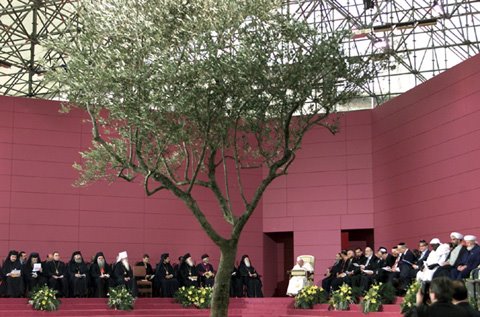
Pope John Paul 11 gathers with world religious Leaders around an olive tree, a symbol of peace, in Assisi (Jan 24, 2002)
|
Flash Cards and Word Memory Games
|
Outcome 1: https://quizlet.com/_2l6w25
Outcome 2: https://quizlet.com/_2lndii Outcome 3: https://quizlet.com/_2p3gww |

| ||
Aspects of Religion
T Texts (sacred texts and other religious writings (such as formal creeds))
R Rituals
I Individual Experience (religious experience and spirituality (characteristic ways of thinking and behaving in the light of beliefs)
B Beliefs
E Ethics (ethical principles and oral or written codes of behaviour)
S Symbols
S Stories (myths and other stories)
S Social Structure
S Sacred Places, Spaces, Time and Artifacts
Complete a table of the identifying aspects of each of the traditions chosen for study this year.
Download the file opposite and complete the table
Short Answer Questions
True or False
1. Rosh Hashana is a Christian festival.FALSE. Rosh Hashana is Jewish New Year
2. Vishnu is an Islamic prophet. FALSE. Vishu is a Hindu God
3. The Hajj is a Hindu feast. FALSE. The Hajj is an Islamic pilgrimage
4. All major world religions have some form of sacred writings. TRUE.
5. Muslims believe that man was created from a clot of blood. TRUE.
6. Lutherans are Christians.TRUE.
7. The holiest city in Islam is Rome FALSE. Mecca is the holiest city in Islam.
8. All religions have symbols.TRUE.
9. Gautama was a Christian during the Roman Empire. FALSE. Gautama (Buddha) lived centuries before the Roman Empire in India
10. Muslims are required to give one fortieth of their income to the poor. TRUE.
11. The cross is a common symbol of the Buddhist. FALSE. The cross is a Christian symbol used since the 4th Century CE.
12. Mahayanna is a branch of Buddhism. TRUE.
13. All religions have founding stories. TRUE.
14. Marriage and Ordination are examples of rituals. TRUE.
15. The synagogue is usually found in the Christian religion. FALSE. Synagogues are Jewish places of worship
16. Baptism is a Christian ritual.TRUE.
17. Mohammed and Jesus Christ knew each other. FALSE. Not in this world. They lived six centuries apart.
18. The two major branches of Islam are Shi’tes and Protestant. FALSE. Shi'ties are Islamic but Protestants are a grouping in the Christian tradition.
19. Mishnah and Talmud are Christian books. FALSE. These are Jewish texts interpreting the Mosaic Law
20. Christian faith has its heritage in Judaism. TRUE. Jesus of Nazareth and his first followers were Jews
Name 2 countries where the following religions are prominent.
Christianity
Buddhism
Islam
Foundations
Students identify the era of the founding story or person for each of the religious traditions being studied.
Approximate Year, Tradition, Founder or Event
40,000 BCE, Aboriginal Society, Movement out of Asia to Australian continent
2000BCE, Hinduism, Arian race arrives from Europe
1200BCE, Judaism, Exodus
500 BCE, Buddhism , Siddhartha Gautama
30 CE, Christianity, Jesus of Nazareth dies
600 CE, Islam, Muhammad (c. 570 - 632 CE)
- What is religion?
- Why are there different religious traditions around the world?
- What are the aspects of Religious Traditions?
- What is theism?
- What is atheism?
- What is agnosticism?
- Name and describe the beliefs of an ancient religion that no longer in existence.
- How might the religions of the world be categorised?
- What is a creed?
- What is the distinction between belief and practice?
- What are the waves of religious experience in the continent of Australia?
- In the study of religions, explain why religious myths are understood to be true.
- What is the relationship between religion and the media in Australia?
- Name a religious leader in Australia and identify some of the issues that are of concern to them.
- What is the theory of the stages of faith development all about?
- What is theology?
- What is a ritual?
- What are some of categories of ritual?
- Choose a religious ritual and describe the beliefs of the religion that are supported by the ritual.
- How do rituals promote collective identity?
- What is ecumenism?
- What is an example of inter-faith dialogue?
- What is the NCCA all about?
- On what grounds might one decide if a country was religious or not?
- What are some examples of significant life experiences that may impact on faith?
True or False
1. Rosh Hashana is a Christian festival.FALSE. Rosh Hashana is Jewish New Year
2. Vishnu is an Islamic prophet. FALSE. Vishu is a Hindu God
3. The Hajj is a Hindu feast. FALSE. The Hajj is an Islamic pilgrimage
4. All major world religions have some form of sacred writings. TRUE.
5. Muslims believe that man was created from a clot of blood. TRUE.
6. Lutherans are Christians.TRUE.
7. The holiest city in Islam is Rome FALSE. Mecca is the holiest city in Islam.
8. All religions have symbols.TRUE.
9. Gautama was a Christian during the Roman Empire. FALSE. Gautama (Buddha) lived centuries before the Roman Empire in India
10. Muslims are required to give one fortieth of their income to the poor. TRUE.
11. The cross is a common symbol of the Buddhist. FALSE. The cross is a Christian symbol used since the 4th Century CE.
12. Mahayanna is a branch of Buddhism. TRUE.
13. All religions have founding stories. TRUE.
14. Marriage and Ordination are examples of rituals. TRUE.
15. The synagogue is usually found in the Christian religion. FALSE. Synagogues are Jewish places of worship
16. Baptism is a Christian ritual.TRUE.
17. Mohammed and Jesus Christ knew each other. FALSE. Not in this world. They lived six centuries apart.
18. The two major branches of Islam are Shi’tes and Protestant. FALSE. Shi'ties are Islamic but Protestants are a grouping in the Christian tradition.
19. Mishnah and Talmud are Christian books. FALSE. These are Jewish texts interpreting the Mosaic Law
20. Christian faith has its heritage in Judaism. TRUE. Jesus of Nazareth and his first followers were Jews
Name 2 countries where the following religions are prominent.
Christianity
Buddhism
Islam
- Christian Countries include: Western European Countries, North & South American continent countries, Australia, New Zealand, South Africa
- Buddhist Countries included Tibet, Vietnam, Sri Lanka, Cambodia, Loas, Thailand. China and Japan also have significant Buddhist influence.
- Islamic Countries include most of the Middle Eastern and Arabic nations, Pakistan, most Northern African Countries and Indonesia
Foundations
Students identify the era of the founding story or person for each of the religious traditions being studied.
Approximate Year, Tradition, Founder or Event
40,000 BCE, Aboriginal Society, Movement out of Asia to Australian continent
2000BCE, Hinduism, Arian race arrives from Europe
1200BCE, Judaism, Exodus
500 BCE, Buddhism , Siddhartha Gautama
30 CE, Christianity, Jesus of Nazareth dies
600 CE, Islam, Muhammad (c. 570 - 632 CE)